



82%
of manufacturers are increasing AI and ERP budgets in 2025–2026 as supply chain volatility forces business-wide digital transformation.



Don’t let the wrong IT partner cost you more than just money. Here’s exactly what to look for.
Don’t let the wrong IT partner cost you more than just money. Here’s exactly what to look for.
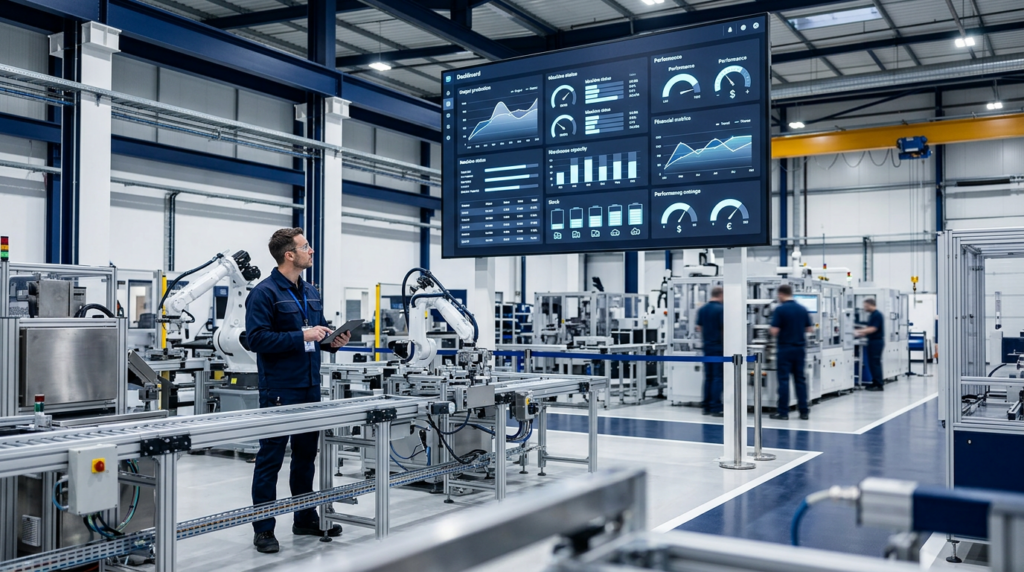
NetSuite is a cloud-based enterprise resource planning platform that helps manufacturing companies unify financial management, inventory management, and production under a single system. Instead of juggling spreadsheets, standalone MRP tools, and disconnected accounting software, manufacturers get one source of truth—from the shop floor to the balance sheet.
Cloud-based ERP provides real-time visibility across operations, and manufacturing efficiency is improved by unifying finance, inventory, and production into a single data layer. Between 2024 and 2026, manufacturers have faced relentless pressure from supply chain volatility, persistent labour shortages, and rising material costs. NetSuite provides real-time visibility across manufacturing operations.
of manufacturers are increasing AI and ERP budgets in 2025–2026 as supply chain volatility forces business-wide digital transformation.
NetSuite for manufacturing is a unified, cloud-based ERP platform designed to serve discrete, batch/process, and hybrid manufacturers. It replaces the patchwork of spreadsheets, standalone inventory trackers, and manual production planning tools with a single system that handles everything from bills of materials to general ledger entries.
NetSuite integrates production, inventory, financials, and customer management in real time. A work order completion automatically updates inventory counts, triggers cost postings, and reflects in financial reports—no rekeying required. Centralizing data reduces human error associated with manual systems, and centralised data facilitates better collaboration among departments.
Typical adopters include manufacturers with 20 to 500 employees, annual revenues between £5M and £200M, and operations spanning multiple warehouses or plants. Many run contract manufacturing or outsourced manufacturing alongside internal production. Industries range from electronics and consumer packaged goods to food and beverage.


Many manufacturing companies start with tools like QuickBooks, Xero, or a lightweight MRP system. These work fine until complexity starts costing real money—missed shipments, inventory write-offs, month-long financial closes. Here are the specific pain points that push growing manufacturers to upgrade their manufacturing ERP:
This section walks through the key features manufacturers rely on day-to-day inside NetSuite. Understanding these capabilities helps you determine which modules match your current needs and which you will grow into. NetSuite's manufacturing functionality is modular—from Work Orders & Assemblies at the foundation through to Advanced Manufacturing for complex, multi-plant environments.
Manage multi-level BOMs, work orders, and routings with real-time scheduling, WIP tracking, and shop floor control. NetSuite's manufacturing workbench enhances resource allocation across every work centre.
Real-time inventory visibility across on-hand, committed, backordered, and in-transit quantities. Lot and serial tracking with full traceability for compliance-heavy industries and automated reorder points.
Connect purchasing, supplier relationships, and manufacturing schedules into one system. Demand forecasting uses historical data and AI-driven analytics to drive material requirements and prevent stockouts.
Fully integrated with production and inventory transactions. Standard versus actual cost roll-ups, variance analysis by work order, and automated revenue recognition eliminate the slow manual close.
Sales teams see available-to-promise dates based on real-time inventory and production schedules before confirming orders. Full quote-to-cash cycle with automated fulfilment across multiple warehouses.
Role-based dashboards with On-Time In Full (OTIF), scrap rates, machine utilisation, inventory turns, and cost variances. Cross-functional reporting links financial profitability with manufacturing yield data.
NetSuite manages bills of materials at both single and multi-level depths, with version control and engineering change management. Work orders can be created from sales orders (make-to-order) or generated for stock (make-to-stock). Routings define the sequence of manufacturing operations—setup time, run time, transfer time—and assign labour and machine resources to each work centre.
WIP and Routing captures labour and machine time per operation, tracks overhead allocation, and calculates standard versus actual costing at each routing step. This level of detail gives production managers visibility into where deviations occur and where production costs can be reduced. NetSuite's advanced manufacturing module supports real-time scheduling, including finite capacity scheduling against actual availability of labour and machines.
Dispatch lists, work centre calendars, and mobile data capture from tablets let shop floor teams record completions, downtime, and scrap as they happen. Real-time data allows quick adjustments to production schedules without waiting for batch updates. Manufacturers can optimise resource allocation by balancing jobs across limited-capacity machines—NetSuite reduces production costs by optimising resource allocation across every work centre.

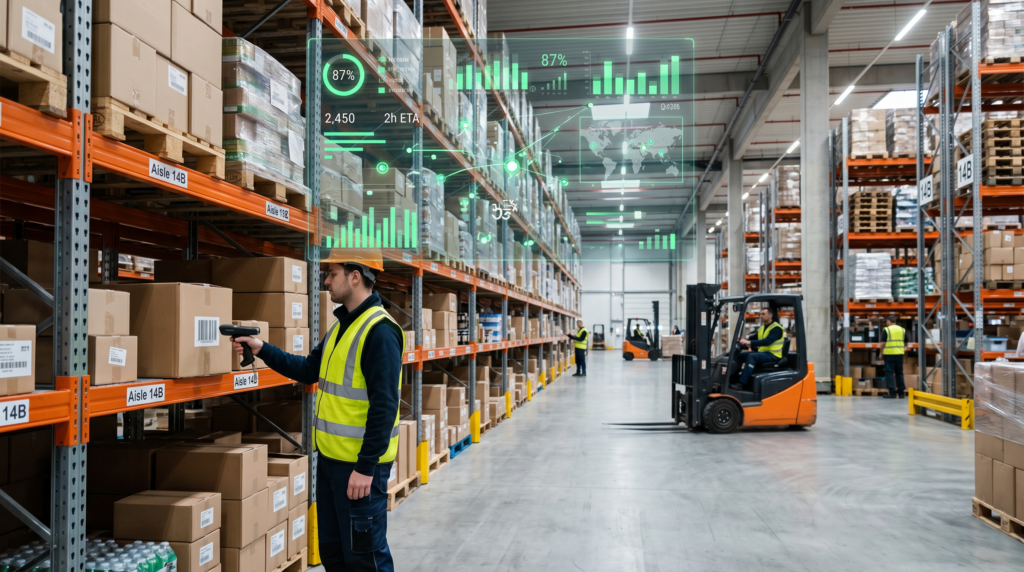
Inventory management is the backbone of any manufacturing business. Balancing raw materials, WIP, and finished goods across multiple locations directly impacts cash flow, delivery performance, and production efficiency. NetSuite delivers real-time inventory visibility across on-hand, committed, backordered, and in-transit quantities—and manufacturers can track items by warehouse, bin location, lot number, serial number, and expiry date.
NetSuite optimises inventory levels based on demand forecasts, using MRP suggestions to generate planned purchase orders that align purchasing with actual customer demand. HC Brands improved inventory accuracy from 60% to 95% across two warehouses by integrating warehouse management with NetSuite—freeing up cash previously locked in mismanaged stock.
NetSuite connects purchasing, supplier relationships, and manufacturing schedules into one system, giving teams full supply chain visibility. Supply chain visibility connects supplier data to production schedules, so planners can see the complete picture from purchase order to finished good.
Demand planning uses historical sales data, open opportunities, and sales forecast inputs to drive material requirements. AI-driven demand forecasting helps optimise production planning by identifying patterns humans might miss. An industry survey found 82% of manufacturers are increasing AI budgets in 2025–2026, with many expecting their ERP to support AI-powered predictive analytics that optimise supply-demand forecasting.
Procurement features include vendor records, purchase contracts, approval workflows, and landed cost calculations for imported materials. A practical example: a manufacturer importing raw materials from Asia used NetSuite's demand planning with supplier lead times to reduce emergency expedite orders by 30%—smoothing cost volatility and improving delivery performance.

NetSuite's financial management is fully integrated with production and inventory transactions. When a work order completes, component costs are consumed, WIP is relieved, and finished goods are received—all posting to the general ledger automatically. Key capabilities include accounts payable and receivable, automated revenue recognition, standard versus actual cost roll-ups, and variance analysis by work order, routing operation, or item.
Unified financial management streamlines procurement and supports multi-currency operations, which matters for manufacturers with global suppliers. Manufacturing businesses can view product profitability by item, customer, or order line because costs are traceable through BOMs, routings, and inventory flows. Financial reporting becomes faster when production data flows in real time rather than through manual reconciliation.
A BDO case study found a food manufacturer saved £12 million annually through improved inventory and production data accuracy, a streamlined tech stack, and elimination of redundant systems. Month-end close compressed significantly once inventory and production data were captured from the shop floor in real time.
NetSuite includes customer relationship management as part of the same platform, sharing the customer record with orders, shipments, service history, and financial data. Sales teams can see available-to-promise dates based on real-time inventory and production schedules before confirming orders to customers.
Order management workflows cover the full quote-to-cash cycle: pricing rules, discount approvals, automated fulfilment across multiple warehouses, and customer management from initial inquiry through delivery. NetSuite automates the entire product lifecycle management for manufacturers, connecting the order fulfillment process to production and shipping.
Customer service teams benefit too. They can see work order status, shipment tracking, warranty details, and returns information from one screen. This improves customer satisfaction, reduces order disputes, and shortens promised lead times. When customer relationships are managed alongside production data, the entire organisation operates from the same playbook.

NetSuite's manufacturing stack is composed of several add-on cloud services layered on the core ERP platform. NetSuite's modular structure allows for tailored pricing based on needs—manufacturers pay for what they use today and add capabilities as business processes mature. The scalability of modular design allows systems to evolve with business needs.
Entry Level
The entry-level manufacturing module for light manufacturing and kitting operations. Handles assemble-to-order, simple kits, and low-volume production. Core capabilities include creating work orders from sales orders, backflushing components on completion, and tracking basic production quantities and yields. Does not include routings or work centre capacity planning.
Ideal for: Small consumer products businesses moving beyond basic inventory transactions.
Mid-Tier
Adds detailed routing, operation-level tracking, and WIP accounting on top of Work Orders & Assemblies. Supports multiple work centres, labour and machine cost capture, queue and setup times, and operation-specific reporting. Manufacturers with multi-step manufacturing processes who need accurate cost roll-ups and performance measurement per routing step benefit most here.
Ideal for: Industrial equipment manufacturers identifying bottlenecks and reducing lead times.
Enterprise
NetSuite's most robust manufacturing solution for complex or high-volume environments. Supports finite capacity scheduling, constraint-based planning, real-time dispatching, and advanced shop floor interfaces. Covers multiple production modes: make-to-stock, make-to-order, configure-to-order, and batch/process manufacturing for process manufacturers.
Ideal for: Multi-plant manufacturers with complex routings and tight capacity constraints.
Add-on Module
Supports compliance and traceability by embedding inspections, sampling plans, and test results directly into production workflows. Quality management systems can ensure compliance with standards like ISO 9001. NetSuite allows manufacturers to monitor quality in real-time during production with non-conformance workflows and corrective and preventive actions (CAPA).
Ideal for: Medical device and food manufacturers preparing for ISO 9001 or regulatory audits.
Real-world manufacturers apply netsuite for manufacturing to solve specific, everyday challenges. Each scenario relies on the same core platform—enabling manufacturers to streamline manufacturing operations without bolting on disconnected tools.
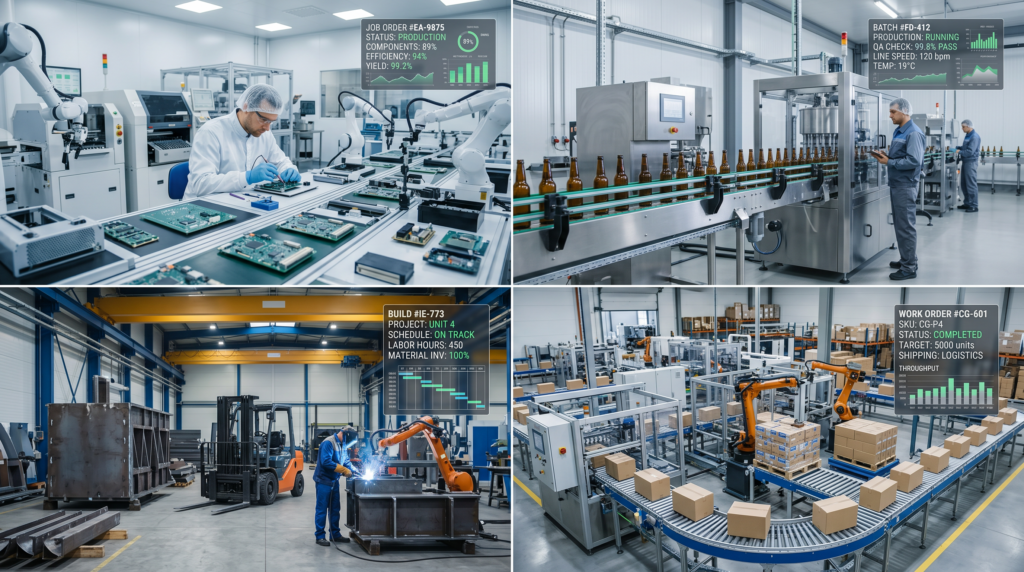
A 75-person custom machining company uses NetSuite's advanced manufacturing for finite scheduling, configure-to-order BOMs, and work order costing. Production managers balance demand across CNC machines using dispatch lists, while finance tracks margins per job in real time. NetSuite offers production planning tools for manufacturers operating in this mode.
A food company uses demand planning with historical sales to forecast seasonal spikes, generating purchase orders for raw materials months in advance. Quality management captures batch traceability for regulatory compliance. NetSuite enhances operational efficiency through centralised data management across procurement, production, and distribution.
A contract electronics assembler manages separate BOMs, pricing, and production schedules per client within one NetSuite instance. Outsourced manufacturing components are tracked alongside internal assemblies, with landed cost calculations for imported parts. Efficient resource allocation across client work orders is managed in a single system.
A hardware startup begins with Work Orders & Assemblies, then adds WIP & Routing as production complexity increases. As the business grows and volume rises, they layer in advanced manufacturing capabilities and quality management to support customer compliance requirements—without switching platforms.
If your manufacturing company is experiencing these signs, you have likely outgrown your current systems. Readiness criteria go beyond frustration—you need leadership commitment, documented standard operating procedures (or willingness to create them), and budget for implementation and training.

Successful NetSuite projects rely on process design as much as software configuration. The technology is only as effective as the processes it supports and the data it runs on. Monitor key performance indicators from day one—scrap rates, yield, on-time delivery, inventory turns, and actual versus standard cost variances—and use them to drive continuous improvement.
01
Know what you are solving for before configuration begins
02
Operations, finance, supply chain, and quality all need seats at the table
03
BOMs, routings, item definitions, work centre setups, and supplier lead times must be clean
04
Conduct time studies for setup, run, and transfer times rather than guessing
05
Planners, buyers, production supervisors, warehouse staff, and finance each need different skills
06
System testing identifies issues before deployment to reduce disruptions during go-live
07
A phased deployment approach eases the transition and lets teams build confidence before adding complexity
08
Standardise processes rather than automating legacy inefficiencies
NetSuite's integrated comprehensive platform supports manufacturing businesses as they scale, from basic assemblies to complex, multi-plant advanced manufacturing operations. It delivers the supply chain management, shop floor management, and financial reporting capabilities that growing manufacturers need—without forcing you onto multiple disconnected platforms.
The right time to move to a proven expertise ERP solution is before complexity becomes costly—not after. When evaluating manufacturing ERP cost, know that cloud-based solutions have lower initial costs than on-premises systems, but total cost of ownership includes implementation, training, and maintenance. The ROI often shows up in cost reduction, faster closes, and freed-up cash from better inventory management.
This website uses cookies to improve your experience. Choose what you're happy with.
Required for the site to function and can't be switched off.
Help us improve the website. Turn on if you agree.
Used for ads and personalisation. Turn on if you agree.